Showing posts with label Rabbit. Show all posts
Tuesday, July 19, 2011

Volcano Rabbit


    True Wild Life | Volcano Rabbit | The Volcano Rabbit also known as teporingo or zacatuche (Romerolagus diazi) is a small rabbit that resides in the mountains of Mexico. Volcano Rabbits are the second smallest rabbit in the world, only the pygmy rabbit is smaller.


    The Volcano Rabbit lives at a high altitude of 3,000 meters above sea level. Grasslands have expanded into the highlands, making it difficult for the rabbit to find food and make their nest holes. Although the Volcano rabbits are not found outside of Mexico there are a handful of isolated populations away from the slopes of the volcanoes but these are very few and far between. The four volcano slopes where these unique rabbits reside are the Tlaloc, El Pelado, Iztaccihuatl and Popocatepetl volcano slopes. 


    Volcano Rabbits make their nests deep in the grass. Not only do they eat the grass, but they also use it to hide from their enemies. Volcano Rabbits feed on zacaton grasses, herbs and the bark of alder trees. During the rainy season they will also eat corn and oats.


    Volcano Rabbits breed throughout the year with a peak during the warm summer. After a gestation period of 38 - 40 days, they will give birth to 1 - 3 young. At birth the youngsters are covered in fur but their eyes are closed. They are weaned after approximately 20 days and they reach sexual maturity at 4 months old.


    Another problem is that the Volcano Rabbits live on an active volcano. If this volcano were to erupt, it would wipe out their small population. So, zoos and preservation centers are working quickly to breed more Volcano Rabbits.
    Source URL: https://logoswallpapers.blogspot.com/search/label/Rabbit
    Visit Logos Wallpapers for Daily Updated Hairstyles Collection

Amami Rabbit

     
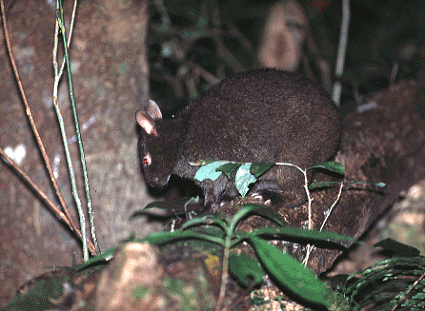
    True Wild Life | Amami Rabbit | The Amami Rabbit  or Amamino kuro usagi, also known as the Ryukyu Rabbit, is a primitive dark-furred rabbit which is only found in Amami Ōshima and Toku-no-Shima in Japan. The dark-furred Amami Rabbit is known as a living fossil. Its characteristics are identical to rabbits who lived five million years ago. With its small ears and dark eyes the Amami Rabbit (Pentalagus furnessi) contrasts greatly with its more familiar fluffy, white relatives, and yet it's the Amami's distinctive features that make this rabbit so important to the study of the animal world. The Amami Rabbit has remained essentially unchanged since the Miocene Epoch of the Neogene Period, or approximately five million years. It is believed that its ancestors diverged from other leporids, or rabbits and hares, approximately 20 million years ago.

    The Amami Rabbit has thick, wooly, dark brown fur that takes on a reddish shade on its underbelly as it ages. It has small ears and small eyes and short legs, but a large, stocky body. It also has a longer face, or snout, than most rabbits. Amami Rabbits do not have tails. They do, however, have long, curved, inch-long nails.


    Baby Rabbits are called kits, kittens, or bunnies. Some sources say the Amami Rabbit only has one kit at a time, and other sources say they have two to three, but it is agreed that they generally have two litters each year. The mother builds a den lined with plant materials and tufts of fur then seals the top with the same material so it looks like the rest of the forest floor. Like other rabbits, the mother leaves her offspring to hunt and only returns every other night in an effort to keep predators from locating her den. She can even feed the kit without completely uncovering the den. She unseals the den when the kit is between four and seven weeks old and the baby rabbit joins its mother on the evening hunt for food.


    The Amami Rabbit eats grass, fresh branches, and nuts. The Amami Rabbit raises its offspring in rabbit holes. Except at times when the mother feeds milk to her offspring, she will cover the rabbit hole with dirt to conceal it. Isn't that clever!


    The reason why the Amami Rabbit retains its primitive form is because this form best suits them for life on the island. But as more people came to the island, the environment started to change. People continued to cut down trees, wiping out sources of food and refuge for the Amami Rabbit. Amami Rabbits are also frequently attacked by mongooses, which were originally brought to the island to exterminate the Habu, a venoemous snake. Today, the Amami Rabbit is on the brink of extinction.
    Source URL: https://logoswallpapers.blogspot.com/search/label/Rabbit
    Visit Logos Wallpapers for Daily Updated Hairstyles Collection


Popular Posts

My Blog List

Blog Archive